
Computational
Chemistry
Lab

Transition Metal Catalysis
Our group studies the mechanisms of transition-metal-catalyzed transformations, combining computational and experimental approaches to uncover reactive intermediates, active species, and the factors that control reactivity and selectivity.
Carbene Insertion Reactions
-
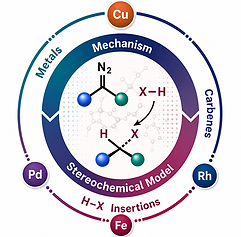
We investigate carbene insertion chemistry across transition-metal catalysts including Rh, Cu, Pd, and Fe using a combined computational and experimental approach.
-
We study the mechanism of carbene insertion into X–H and C–H bonds (X = O, N, S, C(sp²)) and how the metal center governs selectivity.
-
These insights extend to multi-component reactions (MCRs), building structural complexity in a single step with high selectivity.
A. Tyagi‡, K. Gupta‡, G. Jindal, JACS Au. 2025, 5, 4879–4892.
A. Tyagi, K. Gaur, A. Goswami, A. Seal, M. Joddar, G. Jindal, Chem. Sci. 2025, 16, 6793–6804.
Gogoi, R.; Jindal, G. ACS Catal. 2024, 14, 12351−12358.
Fe Catalysis
-
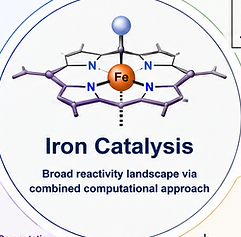
We study the broad reactivity landscape of iron-catalyzed transformations using a combined computational approach, spanning carbene insertion reactions and other C–H and C–X functionalization pathways.
-
A central theme is understanding how spin-state effects across high, intermediate, and low-spin manifolds govern barrier heights, reaction pathways, and product selectivity, with two-state and multi-state reactivity scenarios examined to capture how spin-crossover events influence outcomes.
-
We investigate the role of axial ligands in artificial heme enzymes, correlating computed mechanisms with experimental observations.
-
We additionally study metal-hydride hydrogen atom transfer (MHAT) pathways in iron-catalyzed oxidation reactions.
R. Balhara, R. Chatterjee, G. Jindal, Phys. Chem. Chem. Phys. 2021, 23, 9500.
Rh Catalysis
-
We employ a Synergistic Computational & Experimental Approach to investigate the mechanisms of several rhodium-catalyzed transformations, integrating DFT calculations with a range of experimental techniques to identify active catalytic species.
-
Through rigorous experimental studies: including VT-NMR spectroscopy, high-resolution mass spectrometry, and single-crystal X-ray diffraction: we uncover unexpected mechanistic pathways, such as the dissociation of dirhodium(II) catalysts into highly active monorhodium(III) species, and carry out detailed mechanistic investigations to identify the true catalytically active intermediates.
S. Rawat, D. Sarkar, P. Das, G. Jindal, ChemRxiv 2026, Preprint.*